Anna Wintour’s Vogue Cover Is More Than a Cameo — It’s a Statement
Her rare appearance alongside Meryl Streep may coincide with the rollout of The Devil Wears Prada sequel, but it signals something bigger: a shift from famously private editor to a deliberately shaped personal brand.
In magazine culture, there’s a long-standing tradition when someone leaves a role: colleagues create a playful mock cover in their honor. Think inside jokes, exaggerated headlines, maybe a Photoshopped face on a past celebrity shoot. It’s lighthearted, symbolic—a send-off.
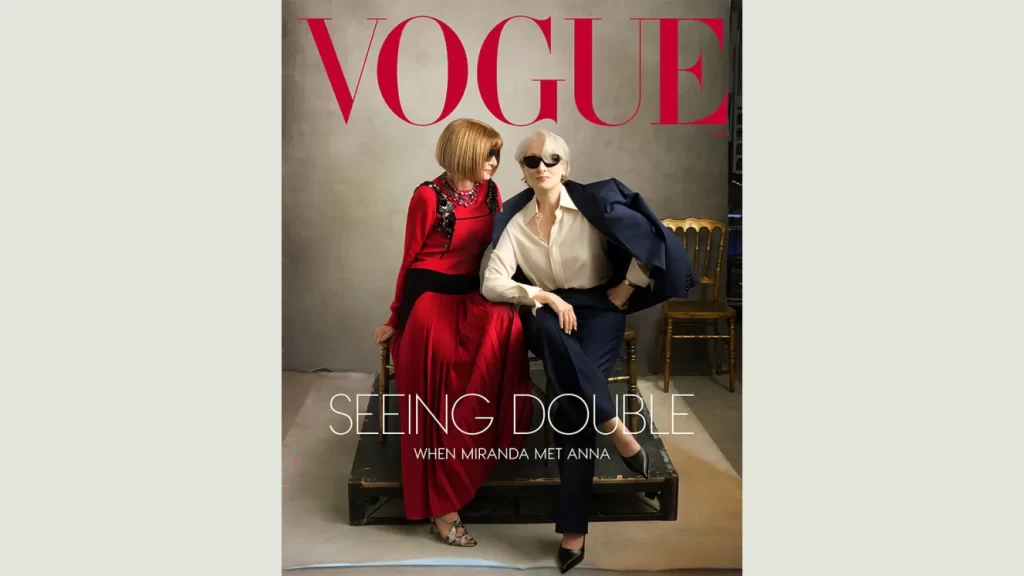
This week, Anna Wintour got her own cover. Only this one isn’t a joke. It’s real, polished, and hitting newsstands on 28 April.
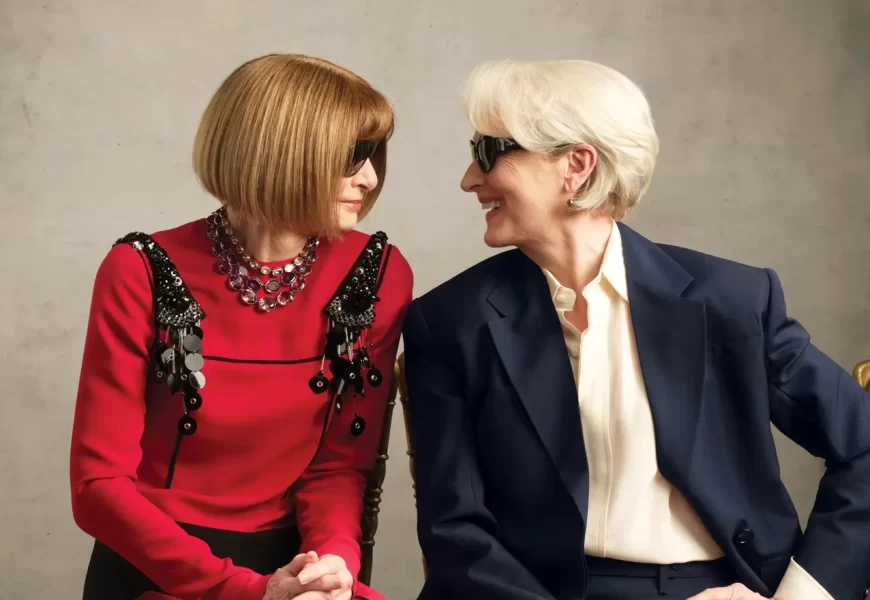
In a move that caught many off guard, Vogue’s May issue features Wintour sharing the cover with Meryl Streep, whose portrayal of Miranda Priestly—the commanding editor of fictional magazine Runway—has long been rumored to draw inspiration from Wintour herself. The headline reads: “Seeing Double. When Miranda met Anna.”
Wintour has appeared on industry covers before—Interview in 1993, Ad Week in 2017—but this marks a first: an editor placing herself on the cover of her own publication. Naturally, both she and Streep are dressed in Prada.
A Viral Moment — And a Calculated One
Teased on Vogue’s Instagram, the image went viral almost instantly, racking up over 1.2 million likes within hours. Reactions poured in from across the industry—Gigi Hadid, Mindy Kaling, and thousands of others chiming in with praise ranging from “groundbreaking” to “framing this immediately.”
But this isn’t just savvy promotion for a blockbuster sequel. It’s something far more strategic.
The cover arrives less than a year after Wintour announced she was stepping back from her role as editor-in-chief, and months after appointing Chloe Malle as head of editorial content. If there were any doubts about her influence, this moment erases them. Appearing on the cover is a clear signal: she’s still firmly in charge.
Power, Reframed
When Wintour transitioned away from the editor-in-chief title, many interpreted it as a step down. This cover tells a different story.
As Condé Nast’s chief content officer and global editorial director, Wintour still holds ultimate authority—while delegating day-to-day operations. It’s a shift in structure, not in power.
PR expert Mark Borkowski calls the move “incredibly smart,” noting that Wintour doesn’t see herself as someone who holds power temporarily—she embodies it. “She’s not someone who fades quietly,” he says. “She is the institution.”
Even the origin of the cover concept reinforces that dynamic. In her editor’s letter, Malle recalls pitching ideas to Wintour from the backseat of her town car—a setting that subtly echoes the world of The Devil Wears Prada. Wintour initially dismissed the idea as “not really my style.” It ultimately took Streep herself to convince her, with Wintour personally reaching out—another quiet flex of influence.
Rewriting the Narrative
Back in 2006, Wintour kept her distance from the original film, offering little commentary despite attending the premiere (in Prada, of course). Years later, her stance has softened. She now refers to Miranda Priestly as a “caricature”—one she clearly finds entertaining.
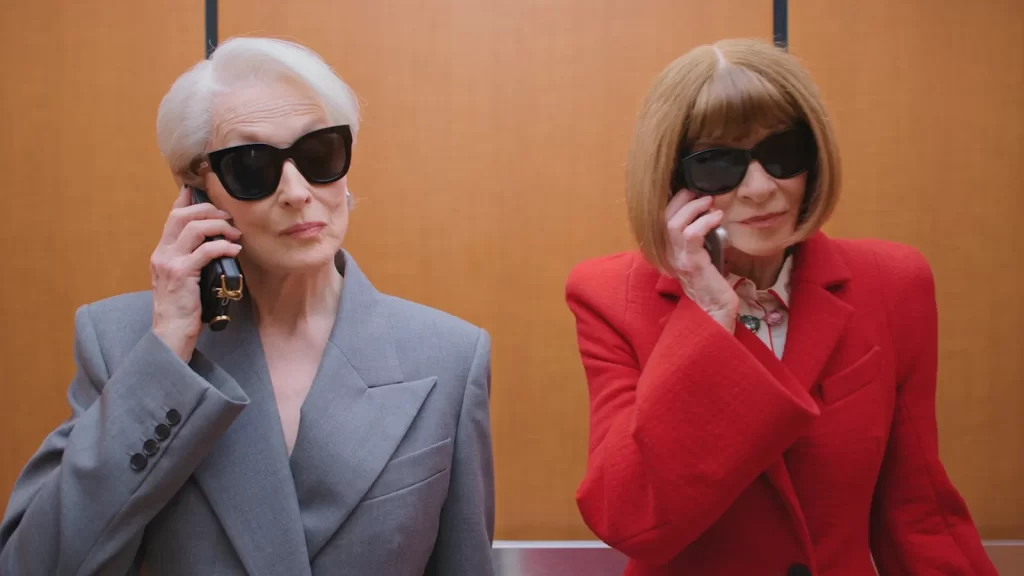
The tone of the current campaign reflects that shift. In accompanying videos, Streep remains fully in character, while Wintour leans into a more relaxed, self-aware version of herself—laughing, missing lines, showing a lighter side that contrasts sharply with Priestly’s icy persona.
She’s been warming to the narrative in other ways too. At the Oscars, she jokingly addressed Anne Hathaway as “Emily,” referencing Emily Blunt’s character. And Vogue’s book club is revisiting the original novel by Lauren Weisberger. These moments aren’t random—they’re deliberate steps in reshaping her image.
The Rise of the Anna Wintour Brand
According to Borkowski, this all points to a broader evolution. For decades, Wintour was Vogue—defined by her signature bob and dark sunglasses, almost mythic in her distance. Now, the focus is shifting.
“It’s about separating Anna Wintour from Vogue,” he explains. “She’s building her own narrative.”
Biographer Amy Odell agrees, suggesting this moment is about legacy. In her Back Row newsletter, she notes that Wintour understands the power of imagery to redirect public perception. High-impact visuals—especially ones that go viral—have a way of rewriting the story.
She draws parallels to past Vogue covers that reshaped public figures’ images, from Hillary Clinton in 1998 to Kim Kardashian and Kanye West in 2014. In each case, the cover didn’t just reflect culture—it influenced it.
Still in Control
Despite her efforts to distinguish herself from the fictional Priestly, the parallels remain hard to ignore. In the original film, Priestly famously declares: “There is no one who can do what I do.”
Two decades later, with the world talking more about Wintour’s cover than the film’s latest trailer released the same day, that line feels less like fiction—and more like fact.